

‘Everyday hero’ recalls her inspiring actions during an off-duty incident on the London Underground
Radiographer Hajara Begum hardly expected to be called upon for medical expertise while on her way home – but after a member of the public collapsed, she found herself putting her skills to the test



By Will Phillips
By Will Phillips
“I am writing to formally nominate Hajara for commendation in recognition of her exceptional compassion, professionalism and dedication.” So reads an unexpected message received by Milton Keynes University Hospital last month after one radiographer found her expertise called upon during a medical emergency on the Underground at London Bridge station.
The message was about Hajara Begum, a senior radiographer and PACS specialist at Milton Keynes University Hospital, where she’s worked for the past eight months. Passionate about teaching, learning and progressing into the profession, Hajara had no inkling that her healthcare expertise would be called upon one October evening at London Bridge Underground station, where she found a woman collapsed and surrounded by a crowd of bystanders. Nonetheless, she rose to the occasion.
Synergy sat down with Hajara to find out more about what happened that day, the importance of visibility for radiographers and her hopes for the future.


‘It is embedded in us to help’
In December last year, a woman experienced a seizure while travelling alone on the London Underground, surrounded by strangers who had no idea how to assist her.
Hajara had been returning from an interview at around 6pm and, as she was coming through the station’s barriers, she witnessed a large crowd of people gathering around something on the station floor. “I pushed them all away and I saw this girl lying down, completely unconscious,” she recalls. “There was someone on the phone to her, calling her name quite loudly, so I spoke to her – she was the girl’s auntie.”
After placing her safely in the recovery position, Hajara remained by her side for nearly two hours, throughout the entire episode, ensuring she was never left alone or frightened. Her reassurance and kindness helped her to feel safe and, as she grew more responsive, Hajara offered her water and food to help stabilise her, while gathering all essential medical information for the emergency services.


“Hajara turned an extremely frightening experience into one of safety, dignity and compassion,” continued the letter, which was written by the woman’s aunt. “Her calm reassurance, commitment and decisive action had a profound positive impact on my niece and our whole family. Hajara’s actions reflect extraordinary personal character and professionalism.
“Even off duty, she embodied the values of the NHS and your hospital: compassion, courage, responsibility, respect and dedication to the wellbeing of others. Her actions went far beyond what any member of the public could be expected to do. She is, without doubt, an exceptional representative of Milton Keynes University Hospital and a true everyday hero.”
Once in contact with the woman’s aunt, and ensuring another member of the public was taking her details for the emergency services, Hajara went through the ‘ABCDE’ method of resuscitation: Airways, Breathing, Circulation, Disability, Exposure.
Fortunately, it wasn’t long before she got a response. Hajara gave her a Mars bar, as sweet foods can help with seizures. “I was just thinking – I’ve got three younger sisters,” Hajara says. “If that was my sister, I would want someone to look after them the way I was doing. I was just squeezing her hand, trying to get her to wake up. I kept saying her name.”

Eventually, she began to wake up. Once the ambulance crew arrived, however, Hajara stuck around, not wanting her to be alone in such a situation. “I really didn’t expect that sort of thing,” she admits. “I hope that someone would also do that for me. You never know – it could be us tomorrow, could be my sister, could be anyone. You hope people would help – but there’s a lot of bystanders. I was too focused to think about it.
“[As radiographers], we’re really nervous at the beginning of our careers. But over time, you gain a level of confidence and that nervousness goes away. The minute I saw her, I was just tunnel visioned on making sure she was OK. I wanted to help get things sorted. I felt like I was on a mission. It’s embedded in us as NHS professionals, as healthcare professionals, to help.”

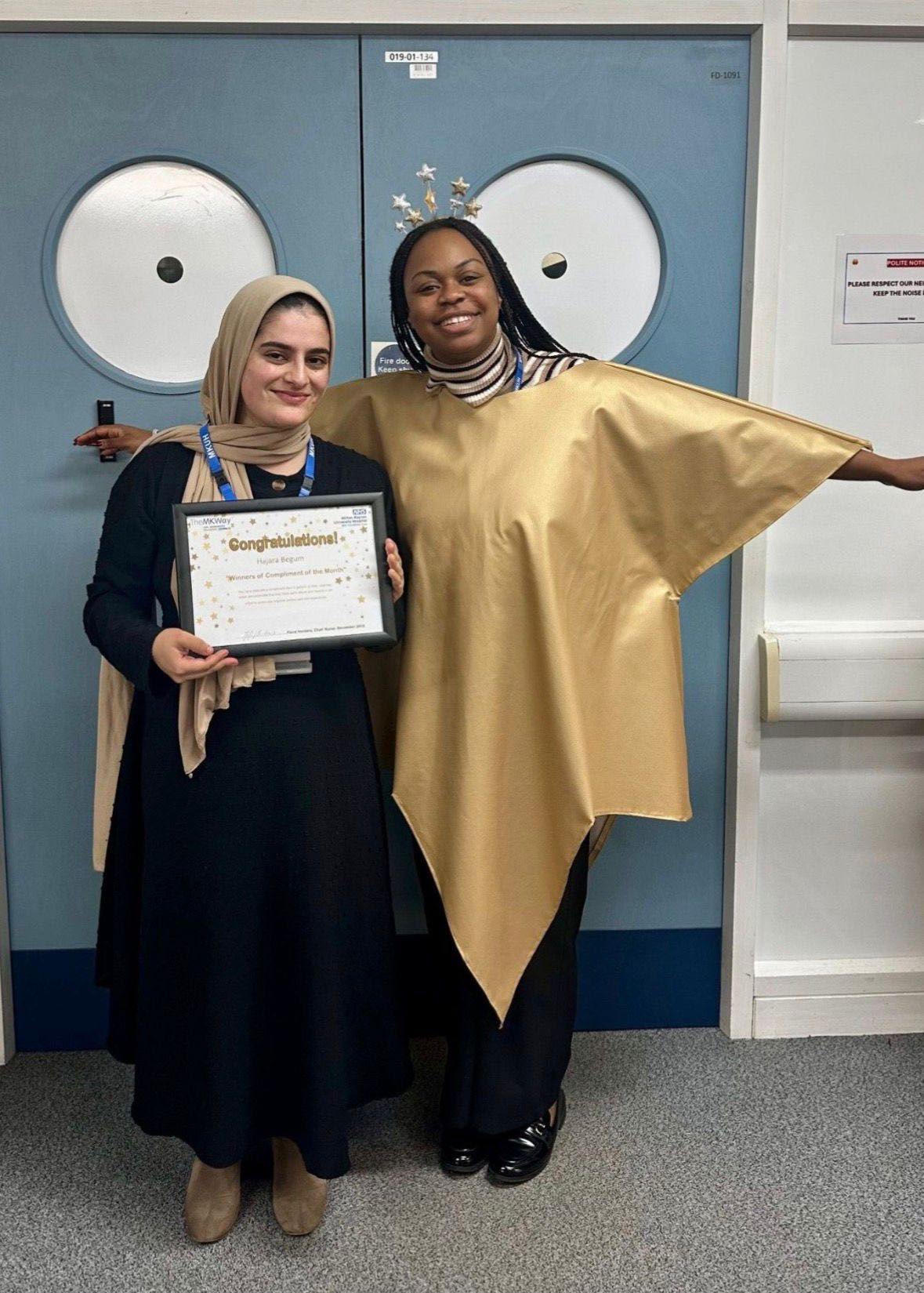
Hajara receiving the ‘Compliments of the Month’ award
Hajara receiving the ‘Compliments of the Month’ award
Hajara’s efforts were recognised by Milton Keynes University Hospital when it awarded her its ‘Compliments of the Month’ award. She received a certificate and a letter from the CEO, expressing how proud he was of her for being able to help in such a scary situation.
A 24/7 job
Hajara’s time as a radiographer began in 2021, when she became an apprentice at Chelsea and Westminster Hospital NHS Foundation Trust. After completing her time there, she moved on to John Radcliffe Hospital in Oxford and then to Milton Keynes Hospital. After a flurry of CPD, personal improvement and promotions, Hajara now finds herself taking on a new challenge as a Band 7 radiographer at East Surrey Hospital, where she intends to complete a postgraduate certification in medical education.
In her role at East Surrey, Hajara hopes to do more to help her fellow radiographers and to promote the profession. Her work there will involve looking after students and supporting CPD. “A lot of people don’t know what radiographers are,” she says. “They still think we’re doctors or nurses. In the situation [on the tube], people might think it would have been more beneficial for there to be a nurse or a doctor around. However, as radiographers, we still do life support training so that we can look after our patients.”

In her new role, and with her upcoming post graduate certificate, Hajara hopes to be able to support radiographers on the management side as well. However, she’s open to the many options that are available for staff. “It’s more a case of what opportunities come up,” she explains. “I was originally going to go into something like sonography or reporting. Then the opportunity for this postgraduate certification came up, and a lot of people pointed out that I’m quite good with students and with CPD. I looked into it, and I loved it.
“Radiography is difficult but exciting, because there’s so many avenues you can go into. My intentions now compared to when I first started are completely different. I’m doing the polar opposite of what I thought I would when I was a Band 5. But I’m so happy that I’ve done that.”
Hajara says the number one thing she tells students is to stay enthusiastic and proactive. Radiographers might not know who they will be working with in the future, whose paths they might cross and who might benefit from support at a critical moment. “This job is with us 24/7,” she continues. “We don’t just do it here – we do it everywhere. Go for every opportunity you get, whether it’s mentoring, assessing, whatever. I was often told I was being too quick with my progression; had I listened to that advice, I would not be where I am now. Make sure you believe in yourself and always be kind.”

Hajara Begum
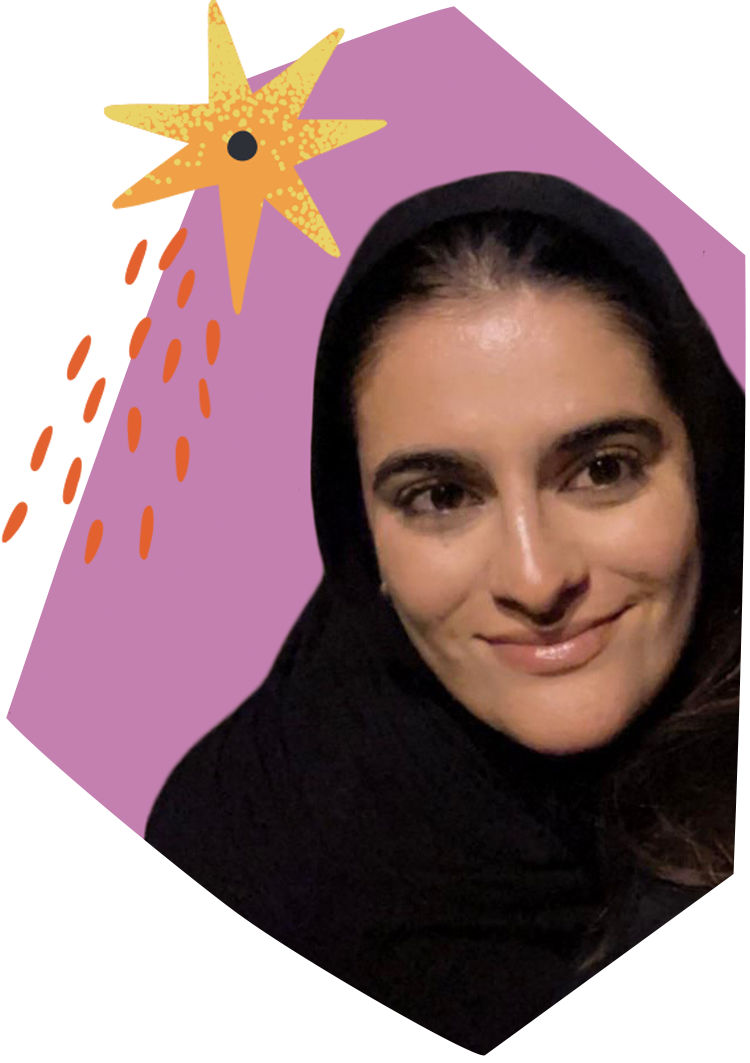
Hajara Begum



The key to success
Hajara’s journey into radiography was a little more roundabout than most. She initially went to the University of Hertfordshire in 2018 when she was 18, beginning her studies in radiotherapy. But after a year, Hajara realised it just wasn’t for her.
She decided to take a year’s break to travel and work across different jobs, including retail and care. But, she says, it wasn’t enough: “I knew I wanted to do something more. I knew I didn’t want to be a nurse or a doctor. I looked for a long time, and this diagnostic radiography job came up as an apprenticeship.”
Hajara took a few days to shadow radiographers in the hospital, and fell in love.

In fact, Hajara was a part of the second cohort of diagnostic radiography apprentices in the whole of the UK, beginning in 2021. The high demand for this apprenticeship meant she had to work twice as hard to ensure she was successful in the interview for an apprentice radiographer at Chelsea and Westminster Hospital NHS Foundation Trust for three years. Commuting every day from Aylesbury (a two-hour round trip) was no obstacle – and after completing the scheme Hajara secured her first job, at the John Radcliffe Hospital in Oxford as a Band 5 radiographer. “It is one of the best things I have ever done. You get an honours degree from it but you also get paid as a Band 4 radiographer, which is brilliant,” she explains.
“You’re in university less but you’re in the workplace more. And the staff at Chelsea really looked after me, especially Laura Oldfield. She is the person who has shaped me into the kind radiographer I am today.”

Hajara remained at John Radcliffe for around six months before being promoted to Band 6 radiographer/PACS specialist at Milton Keynes University Hospital, where she has been for the last six months.
“I’m really proud of the amount I’ve managed to get done,” she says. “I’ve done a lot of CPD courses and, while I was at Chelsea and Westminster Hospital, we won an award for radiology services. While I was at John Radcliffe I did a lot of mentorship, helping students and working closely with the children’s paediatric radiology team, who were like my second family.
“Obviously it’s harder as an apprentice to manage the academic time with the clinical time, and it was a lot of pressure. But it worked out and I wouldn’t change it!”
Hajara holds monthly CPD sessions with an agency radiology services lead, Sohail Bhana, including one last month focused on radiation safety in theatres. At the end of it, attendees received a certificate that could go on their Health and Care Professions Council audit, which happens every two years.
Outside of work, Hajara attends a women-led fitness class, where she uses mini trampolines for exercise alongside flexibility training. She also enjoys spending time with family and friends. “It is hard to maintain and balance everything out at the moment,” she adds. “But with my role now I’m on flexible working, which has been accommodated to me, so it’s been easier.”

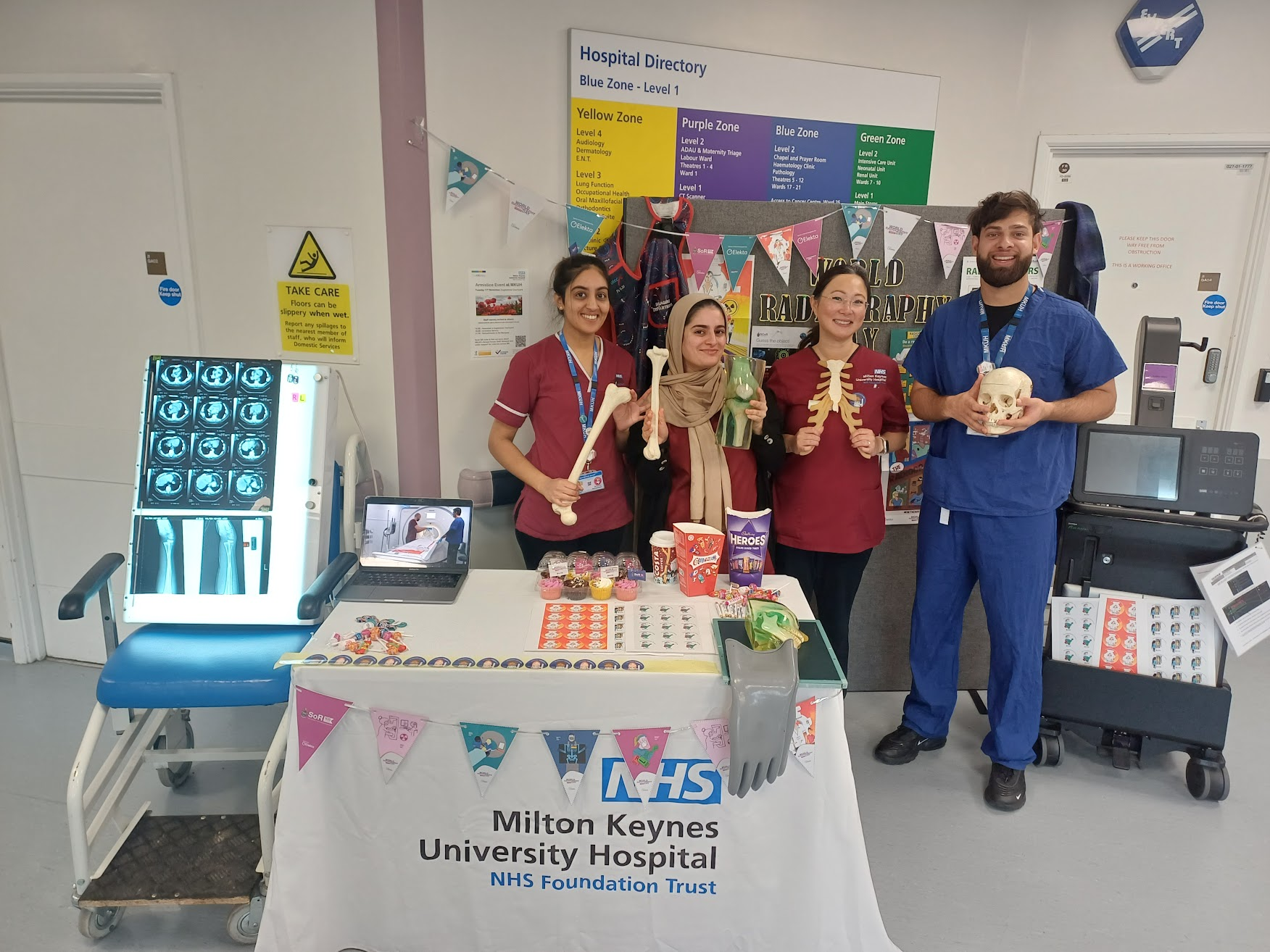
Hajara was also elected at Milton Keynes Hospital as an SoR union learning rep. She didn’t know much about the role at the time – not even that there were other kinds of reps – but one of her senior colleagues, Michael Fell, an industrial relations rep for several years, suggested she look into the topic. Discovering that it was all about teaching, Hajara had an immediate realisation. “It was definitely my forte,” she says. “This is what I love – teaching people, helping them learn new things. I love learning; I think education is the key to success.”
Read more