
‘You are the future of the profession’ – inside the SoR Annual Student Conference 2026
At this year’s event, attendees were encouraged to prioritise professionalism and promote inclusivity. Synergy looks at the conference highlights and the key lessons students took home
By Marese O'Hagan
By Marese O'Hagan
Don’t compare yourself to others – that was one of the key takeaways from the SoR’s Annual Student Conference 2026.
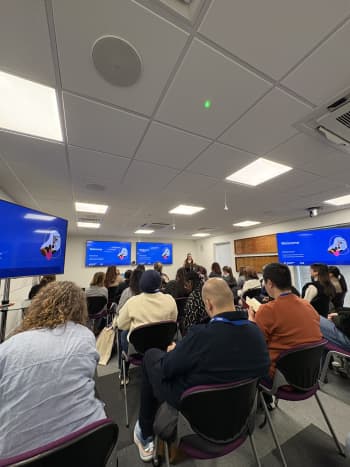
The society’s student members gathered on Thursday 12 March at SoR HQ in Bermondsey to learn more about what the society can do for them and to develop their own professionalism and career journeys. The SoR’s educational and career support was showcased, as well as its safe spaces to connect and learn through the various SoR Equalise networks.
But there was also a clear awareness of how complex the radiography learning experience can be for students and early career radiographers. The conference was bookended with encouragement for the student attendees to not compare themselves to others on their career path, and instead focus on their own educational and career journeys.
Here, Synergy recaps the event and finds out what impacted students the most.
Get involved
Katie Thompson, president of the Society of Radiographers, kicked off the day with a message of discouraging comparison in her presidential address. Standing at the front of the conference room, Katie told the audience of eager students what she wished she’d known when she was a student radiographer – most notably that your career journey will be different to others. While others might progress quickly, “everybody’s journey is different, and that’s OK”, she said.
Katie Thompson, SoR president
Katie Thompson, SoR president
She also encouraged the students to face their failures – “we should go forward, we should learn from them” – and prioritise opportunities to connect with others, including at events like the student conference. “There is nothing like the connections you make on days like this with other people from different areas… get their contacts, get their email addresses,” she continued.
This idea of taking every opportunity at hand was echoed by Leandre Archer, head of industrial relations at the SoR, in her session, as she shared that she was once approached on a dancefloor to talk about becoming involved with the SoR.
She stressed the importance of joining the society as a student, even though the value of being part of a trade union might not be obvious so early in a career. Radiographers are there in the hardest time a patient has in their lives, she said, and the SoR can help offer professional guidance to support radiographers in their role.
Represent the profession
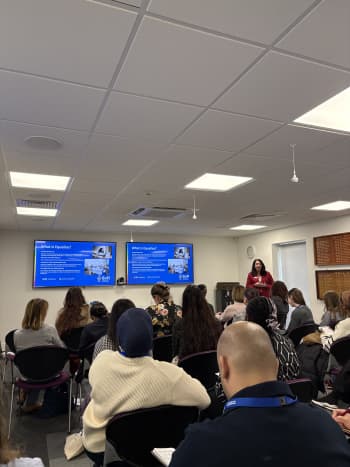
The first two presentations of the day were centred on what the society can do for students. Just before a quick mid-morning refreshment break, Eastern regional officer Rebecca Austin conducted a session on professionalism, marking a turn in the discussion to what students can do for the profession.
Rebecca Austin outlining HCPC standards
Rebecca Austin outlining HCPC standards
Rebecca’s presentation delved into why professionalism matters, focusing on building up public trust and public confidence in radiography. She told attendees that having pride in the profession means being accountable for how it is perceived.
Importantly, Rebecca warned students that professionalism doesn’t end at the hospital doors – it extends to situations such as social drinks with colleagues, Christmas parties and even the hospital car park. If someone sees a healthcare professional experiencing road rage in the car park, that could reflect badly on the profession, she said. “Your reputation is built when no one is formally assessing you,” she explained. “You are the future of the profession – you are the profession now.”
Lessons in employability
The afternoon began with a presentation on employability from Baruch Videan, an advanced practice reporting radiographer at Stockport NHS Foundation Trust.
With the radiographer workforce shortages a prominent campaigning issue for the SoR, conversations around employment and employability are more relevant than ever. Students listened as Baruch encouraged them to think about what makes them employable. Radiography departments will know you’re qualified, he said, but what will make them put you on a shortlist for an interview? What makes successful applicants stand out?
Baruch recommended the students personalise applications and use their own experiences to set them apart. For example, playing the piano or being part of a sports team might not be directly relevant to practising radiography, but they do show drive and passion for something outside of work.
He also reminded the room that radiography courses, talks, certificates, events and conferences can all be connected to continuing professional development (CPD), and told the students to keep track of CPD experiences. “Everything you experience is CPD if you want it to be,” Baruch concluded.
From experience to CPD
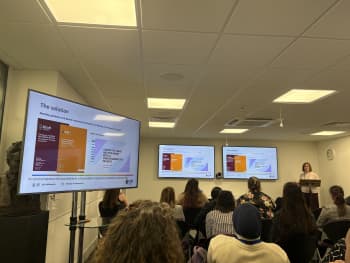
The CPD theme continued after the lunch break. Julie Mills, the SoR’s professional officer for education and accreditation, delivered a presentation on how the SoR can support students’ CPD journeys. “All of us in this room are learners all of the time, throughout our careers,” she said, bridging the gap between the students in attendance and the professionals leading the conference.
Julie Mills takes students through the importance of CPD
Julie Mills takes students through the importance of CPD
But CPD for radiographers doesn’t end at mandatory training or attendance at events, Julie warned. “Just being here today will not be enough in terms of reflective pieces around your CPD,” she said, going on to ask if the students were developing their practical skills in line with CPD features.
To help students frame their learning, Julie explained models of reflection and spoke about reflective cycles, which involve evidencing the evaluation of learning, structuring reflection and challenging assumptions.
Her presentation ended with a simple message: stay critical and curious. “We are here to support you,” she said.
Inclusivity at the heart
Towards the end of the day, the conference schedule addressed one of the most critical aspects of healthcare – inclusivity. Namely, the role of radiographers in supporting and advocating for a more inclusive culture.
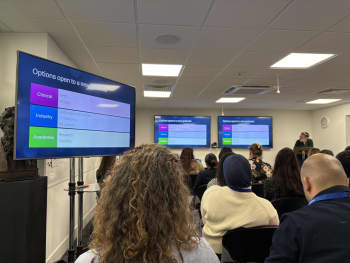
Lynda Johnson, SoR professional officer for clinical imaging, presented on the importance of fostering an inclusive culture. The presentation was based around the impact of a wording change in the updated Ionising Radiation (Medical Exposure) Regulations (IR(ME)R), which came into effect in February 2018. The 2000 edition of the IR(ME)R stated: “Employers must have a written procedure for making enquiries of females of childbearing age to establish whether the individual is or may be pregnant or breastfeeding.” The IR(ME)R 2018 replaced ‘females of childbearing age’ with ‘individuals of childbearing potential’.
Lynda spoke about how the best way to resolve confusion over the change was to publish guidance on the impact of IR(ME)R and develop gender awareness education and training and measure the impact. However, employers misinterpreted the legislation, the media sensationalised the guidance and inappropriate age groups were being asked if they were pregnant.
Lynda concluded her presentation by encouraging students to support inclusivity and ensure it remains a top priority for them, emphasising that it must matter to them personally. “It is an absolute privilege to be a healthcare professional,” she reminded the attendees. “It is not a position of power.
“We’re not just accountable as healthcare professionals for our actions. We are also accountable for our inactions.”

Jenna Pearson, a third year student at Glasgow Caledonian University
Jenna Pearson, a third year student at Glasgow Caledonian University

Student attendee Samsam Mahdi
Student attendee Samsam Mahdi
A chance to connect
As the conference schedule ticked on, Synergy caught up with student attendees to find out what had made the most impact on them during the day.
Jenna Pearson is a third-year student at Glasgow Caledonian University. She thought the presentations were relevant to her learning and enjoyed the opportunity to network with fellow students. “Today has been really good, really incisive,” she told Synergy.
In particular, Jenna found the presentations about inclusive practice and radiation safety helpful, and enjoyed the networking opportunities. “It has been really nice networking and getting to meet everybody who’s here. And getting an insight into what it’s like being qualified, and the things that can help going forward.”
Samsam Mahdi was also at the conference. A second year student at London South Bank University studying diagnostic radiography, she is an engaged student member with the SoR, having attended UKIO as a society representative in June last year.
This was Samsam’s second time attending the Annual Student Conference. She said this year’s event was “just as engaging, informative and valuable as the previous one”, and particularly enjoyed the focus on the radiographer student journey. “The talks about the student journey as a radiographer, all the way to career progression, were refreshing,” she said. “Short and insightful, the speakers explored building your career, professionalism and the support the SoR offers along the way.
“The speakers gave us tips and advice on how to go about being a radiographer. And they highlighted that learning from our mistakes and embracing anxiety are all part of the journey.”
Making waves
On a day packed with personal, educational and professional insight, Nichola Browne, the SoR’s students and new professionals officer, took up the final stretch of the conference and led a session on leadership.
Nichola brought attendees through the key characteristics of positive disruption in the workplace and posed examples of red flag phrases in organisational setups like radiography departments, including ‘if it’s not broke, don’t fix it’ and ‘this is the way we do things here’.
In an interactive game, attendees were encouraged to “rock the boat – but don’t fall out”. A student would give an example of a situation that they thought needed rectifying, and Nichola brought the room through what she coined as ‘the boat analogy’ – a way of assessing when to speak up to improve a situation, and how to do that appropriately.
Key characteristics of positive disruption
Key characteristics of positive disruption
With her leadership session wrapped up, Nichola led the day’s conclusion. She told attendees that, ultimately, “you can never forget how it feels to be a student”, and encouraged them to use that feeling to improve the landscape for those coming behind them. “We have learned how versatile your degree is and how much you can do with it,” she added. “This room has been full of so much potential, so much talent.”
Don’t be afraid to fail
What students said they gained from the 2026 Annual Student Conference was twofold. On one hand, they were given the opportunity to learn about how they can benefit from the society’s support. On the other, they were encouraged to take in other points of view to strengthen their own journeys – and, most importantly, to dispel professional hesitation.
This message was strengthened by Nichola’s remarks to the students just before the conference ended, which brought perhaps the day’s strongest lesson to the forefront: “Everyone’s journey can be different – don’t be afraid to fail.”
More about SoR student membership resources
The SoR has so much to offer learners. As well as having a reduced rate for student membership – £17.75 for two years – students benefit from career support and guidance, as well as a broad range of dedicated resources and events.
Additionally, the Society campaigns for pay and recognition for members and offers payment breaks for those on maternity, paternity and adoption leave.
To find out more about what the society can offer students, visit the SoR’s student page here.
Read more